



Online, people always ask for recommendations of right-wing and Christian science fiction, as the myth that such works don’t exist still gets propagated in all of these spaces. I’ve compiled a list of great books that stand the test of time.
The Moon Is A Harsh Mistress – Robert A. Heinlein

Heinlein’s 1966 masterpiece follows a lunar penal colony’s revolution against Earth’s oppressive governance. The novel explores libertarian political philosophy through the story of Manuel Garcia “Mannie” O’Kelly-Davis, a computer technician who helps organize the rebellion alongside Mike, a self-aware supercomputer, and Professor Bernardo de la Paz, a rational anarchist. The book champions individual liberty, limited government, and the right to self-determination. Heinlein presents a society built on voluntary cooperation rather than state coercion, where personal responsibility and free markets create prosperity. The novel’s famous acronym TANSTAAFL, ”There Ain’t No Such Thing As A Free Lunch,” encapsulates its economic philosophy. The Moon Is A Harsh Mistress is right-wing in its celebration of armed resistance against tyranny, its skepticism of centralized authority, and its argument that free people organizing voluntarily can accomplish what governments cannot.

This omnibus collects the first two volumes of Gene Wolfe’s Book of the New Sun—The Shadow of the Torturer and The Claw of the Conciliator. Set in a dying Earth’s far future, the series follows Severian, a journeyman torturer exiled from his guild after showing mercy. Wolfe’s dense, literary prose demands careful reading as Severian’s unreliable narration conceals as much as it reveals. The work is deeply Catholic in its exploration of grace, redemption, and resurrection. Severian’s journey from torturer to potential savior mirrors Christ’s path, with the mysterious Claw serving as a symbol of divine intervention. Wolfe, a devout Catholic, embedded theological themes throughout: the nature of suffering, the possibility of redemption for even the worst sinners, and the idea that grace operates beyond human understanding. The book is Christian in its insistence that mercy and compassion can transform both giver and receiver, and that even in a fallen world, resurrection remains possible.
The Space Pirates of Andromeda – John C. Wright

Wright’s space opera blends swashbuckling adventure with serious theological and philosophical themes. Wright, a Catholic convert, explores questions of faith, free will, and divine providence through action-packed storytelling. The book is Christian in its portrayal of a universe where God’s plan operates even in the darkest circumstances, where individual choices matter eternally, and where redemption remains possible for anyone. It’s right-wing in its celebration of heroic masculinity, its skepticism of centralized galactic government, and its argument that traditional virtues remain essential regardless of technological advancement. Wright’s prose is dense and literary, demanding engagement while delivering genuine adventure. The novel presents a cosmos where spiritual warfare is as real as physical combat, and where faith provides strength that technology cannot.
A Canticle for Leibowitz – Walter M. Miller Jr.

Miller’s 1959 post-apocalyptic novel spans centuries, following a Catholic monastery’s efforts to preserve knowledge after nuclear war destroys civilization. The book is divided into three sections: Fiat Homo, Fiat Lux, and Fiat Voluntas Tua. Each section or short story is set hundreds of years apart as humanity slowly rebuilds. The monks of the Albertian Order of Leibowitz copy and preserve pre-war documents they don’t understand, maintaining faith that knowledge will matter again. Miller, a Catholic convert haunted by his World War II service, created a profoundly religious work exploring cyclical history, the relationship between faith and reason, and humanity’s tendency toward self-destruction. The novel is Christian in its portrayal of the Church as civilization’s guardian during dark ages, its meditation on free will and original sin, and its suggestion that human nature remains constant despite technological progress. The book argues that without moral and spiritual development, scientific advancement leads only to more efficient methods of destruction.
The High Crusade – Poul Anderson

Anderson’s 1960 novel follows medieval English knights who hijack an alien spaceship in 1345 and accidentally conquer an interstellar empire. Sir Roger de Tourneville and his men, preparing to join King Edward III’s French campaign, capture a Wersgor scout ship and force the alien pilot to take them to France. Instead, they end up on a distant planet and must use medieval tactics, faith, and cunning to survive and eventually dominate technologically superior aliens. The book is both Christian and right-wing in its celebration of Western medieval Christendom as a superior culture. Anderson, himself a libertarian, presents the knights’ feudal society as more resilient and adaptable than the decadent, bureaucratic alien empire. The novel argues that moral courage, tactical intelligence, and strong leadership matter more than technology. It’s unapologetically pro-Western, showing Christian warriors defeating aliens through superior spirit and strategic thinking.

Pardoe’s 2024 novel imagines a near-future America that’s been completely coopted by an SJW government. The story follows multiple characters as they organize guerrilla warfare against occupiers. Pardoe, a military historian and wargame designer, brings tactical realism to the invasion scenario while exploring themes of patriotism, sacrifice, and national survival. The book is right-wing in its warning about American decline, its celebration of Second Amendment rights as essential to resistance, and its portrayal of traditional American values as crucial to survival. It’s implicitly Christian in its emphasis on sacrifice for others, the importance of faith communities in crisis, and the idea that some principles are worth dying for. Blue Dawn serves as both thriller and cautionary tale about what happens when a nation loses the will to defend itself.
Out Of The Silent Planet – C.S. Lewis

Lewis’s 1938 novel launches his Space Trilogy with the story of Dr. Elwin Ransom, a philologist kidnapped and taken to Mars (Malacandra) by two villains planning to offer him as a human sacrifice. Ransom escapes and discovers Mars is inhabited by three intelligent species living in harmony under the guidance of angelic beings serving Maleldil (God). Lewis uses the story to explore Christian theology through science fiction, presenting Earth as “the silent planet,” cut off from the rest of creation by humanity’s fall. The novel is explicitly Christian in its cosmology, where planets are governed by angelic intelligences, where unfallen rational beings live in obedience to God, and where Earth’s corruption is an aberration rather than the universal condition. Lewis critiques materialist philosophy and imperialist attitudes through the villains, who see other worlds as resources to exploit. The book argues that Christian metaphysics better explains reality than scientific materialism, and that humanity’s problems are spiritual rather than merely social or political.
Ender’s Game – Orson Scott Card

Card’s 1985 novel follows Andrew “Ender” Wiggin, a brilliant child recruited into Battle School to train as humanity’s weapon against an alien invasion. Ender’s tactical genius makes him the military’s best hope, but his empathy and moral awareness create internal conflict as he’s manipulated by adults who see him as a tool. The novel explores leadership, the ethics of war, and the cost of victory. Card, a devout Mormon, embedded religious themes throughout: the idea that understanding your enemy completely leads to loving them, the burden of responsibility for those with great gifts, and the possibility of redemption even after terrible acts. The book is Christian in its emphasis on compassion, its exploration of guilt and atonement, and its argument that true strength includes moral awareness. It’s right-wing in its portrayal of military necessity, its recognition that evil exists and must be confronted, and its celebration of individual excellence and leadership. Ender’s journey from warrior to Speaker for the Dead (in sequels) mirrors a path from Old Testament justice to New Testament mercy.
There Will Be War – Edited by Jerry Pournelle

Pournelle’s 1983 anthology launched a ten-volume series collecting military science fiction stories, essays, and poetry exploring war’s nature, necessity, and consequences. Contributors include Poul Anderson, Robert Heinlein, and Pournelle himself, offering stories that take military conflict seriously rather than treating it as adventure or condemning it reflexively. The collection is right-wing in its acceptance that war is a permanent feature of human existence, its respect for military virtues and warrior culture, and its argument that strength deters aggression better than weakness. Several pieces explore just war theory from implicitly Christian perspectives, examining when violence is morally justified and what limits should constrain it. Pournelle, a conservative futurist, assembled the series to counter science fiction’s growing pacifist tendencies in the 1970s and 1980s. The anthology argues that understanding war is essential for anyone serious about human nature and political reality.

Simmons’s 1989 novel follows seven pilgrims traveling to the Time Tombs on Hyperion, where the mysterious Shrike awaits. Structured like Chaucer’s Canterbury Tales, each pilgrim tells their story, revealing why they’ve come and what they seek. The novel explores faith, suffering, time, and the relationship between humanity and the divine. Simmons, raised Catholic, embedded Christian imagery throughout: the Shrike’s tree of thorns echoes the crucifixion, the pilgrimage structure mirrors religious journeys, and characters wrestle with the concept of why God permits suffering. The book is Christian in its serious engagement with religious questions, its portrayal of faith as a response to mystery rather than certainty, and its suggestion that sacrifice and suffering can have transcendent meaning. It’s right-wing in its skepticism of technocratic solutions, its respect for traditional religious impulses, and its argument that some questions can’t be answered through reason alone. Hyperion treats religion as essential to human experience rather than primitive superstition to be outgrown.
With these books, one can have the best science fiction journeys right at one’s fingertips. What else would you add?
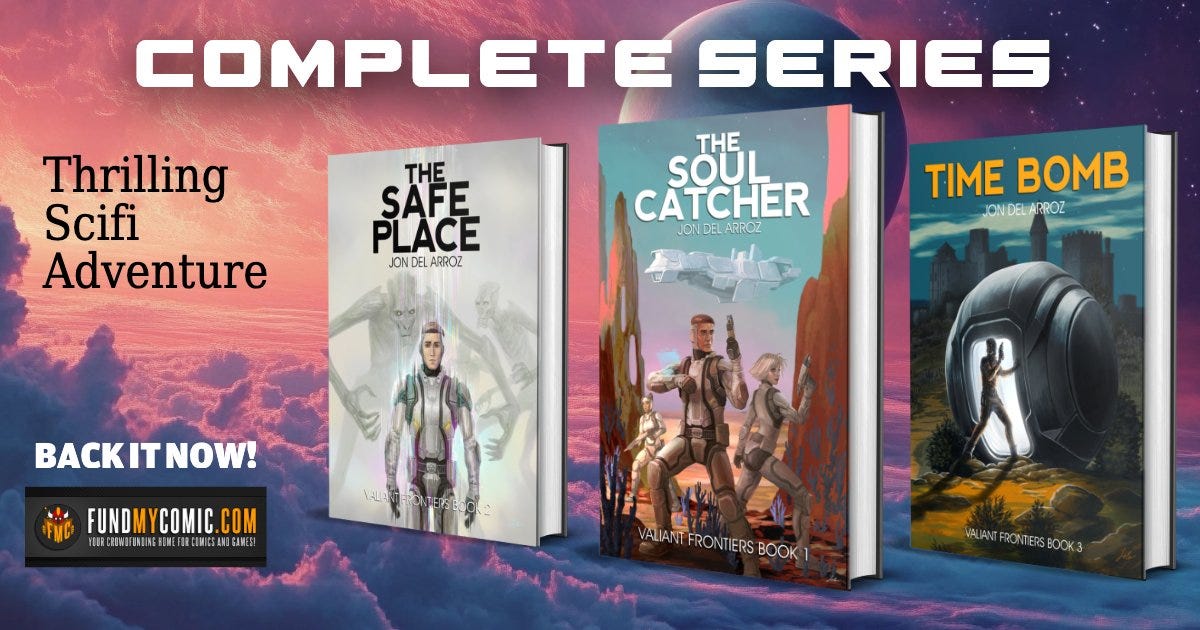
The most based readers can also back a trilogy of some of the best science fiction in years, bringing back the sense of wonder and exploration to the genre. The crowdfund is open now, and if you miss what sci-fi used to be, this is the series for you. Back it today.
Excellent list!
Niven and Pournelle’s The Mote in God’s Eye and Heinlein’s Starship Troopers are also incredibly based must-reads
Great list!!!
There are some on your list that I need to read.