


Last month, we covered 10 Based Science Fiction Books That Should Be In Every Reader’s Library. It ended up being Fandom Pulse’s most-read Substack article of all time (thank you all for reading, subscribing, and helping us fund our full-time journalism!). Since then, we’ve received hundreds of requests to present a list of fantasy books everyone should read. Some of these need no introduction, but others you may be hearing of for the first time. Without further ado, here’s our list.
The Lord of The Rings by J.R.R. Tolkien

Tolkien’s masterwork is the foundation of modern fantasy, following Frodo Baggins’s quest to destroy the One Ring and defeat the dark lord Sauron. The trilogy celebrates traditional virtues—courage, loyalty, sacrifice, and humility—while presenting a deeply Christian worldview without explicit allegory. Tolkien, a devout Catholic, embedded themes of grace, providence, and eucatastrophe (the sudden turn from despair to joy) throughout the narrative. The story champions small, humble people doing great deeds through perseverance rather than power, rejects the corrupting influence of domination, and presents evil as a perversion of good rather than an equal opposing force. The hierarchical societies, the importance of lineage and tradition, the restoration of rightful kingship, and the underlying Christian metaphysics make this essential reading for anyone who believes fantasy should elevate rather than deconstruct.
The Chronicles of Narnia by C.S. Lewis

Lewis’s seven-book series uses fantasy to present Christian theology to children, with Aslan serving as an explicit Christ figure who creates Narnia, sacrifices himself for Edmund’s sins, and returns in resurrection. The books celebrate courage, honor, and faith while warning against pride, greed, and the temptation to power. Lewis, a Christian apologist, crafted stories that work as adventures while teaching theological truths—The Lion, the Witch and the Wardrobe depicts substitutionary atonement, The Magician’s Nephew shows creation and the fall, and The Last Battle presents the end times and final judgment. The series is unapologetically Christian in its worldview, presenting a universe where good and evil are real, where sacrifice matters, and where faith in Aslan (Christ) leads to redemption and eternal life in the true Narnia (Heaven).
Taliesin by Stephen R. Lawhead (The Pendragon Cycle)

The first book in Lawhead’s Pendragon Cycle reimagines Arthurian legend by connecting it to Atlantis, following the last Atlantean princess Charis and the Celtic bard Taliesin as they become the grandparents of King Arthur. Lawhead, an evangelical Christian, weaves Christian themes throughout the pagan Celtic setting, presenting the coming of Christianity to Britain as a spiritual awakening that transforms the land. The novel celebrates traditional masculinity, feminine virtue, the importance of lineage and heritage, and the idea that great leaders are raised and trained rather than simply born. The book presents a vision of Christianity as the fulfillment of pagan longing rather than its destruction, showing how the best of Celtic culture was preserved and elevated by faith. Lawhead’s prose is literary and mythic, treating legend with reverence while grounding it in historical plausibility.
A Throne Of Bones by Vox Day (Arts of Dark and Light)
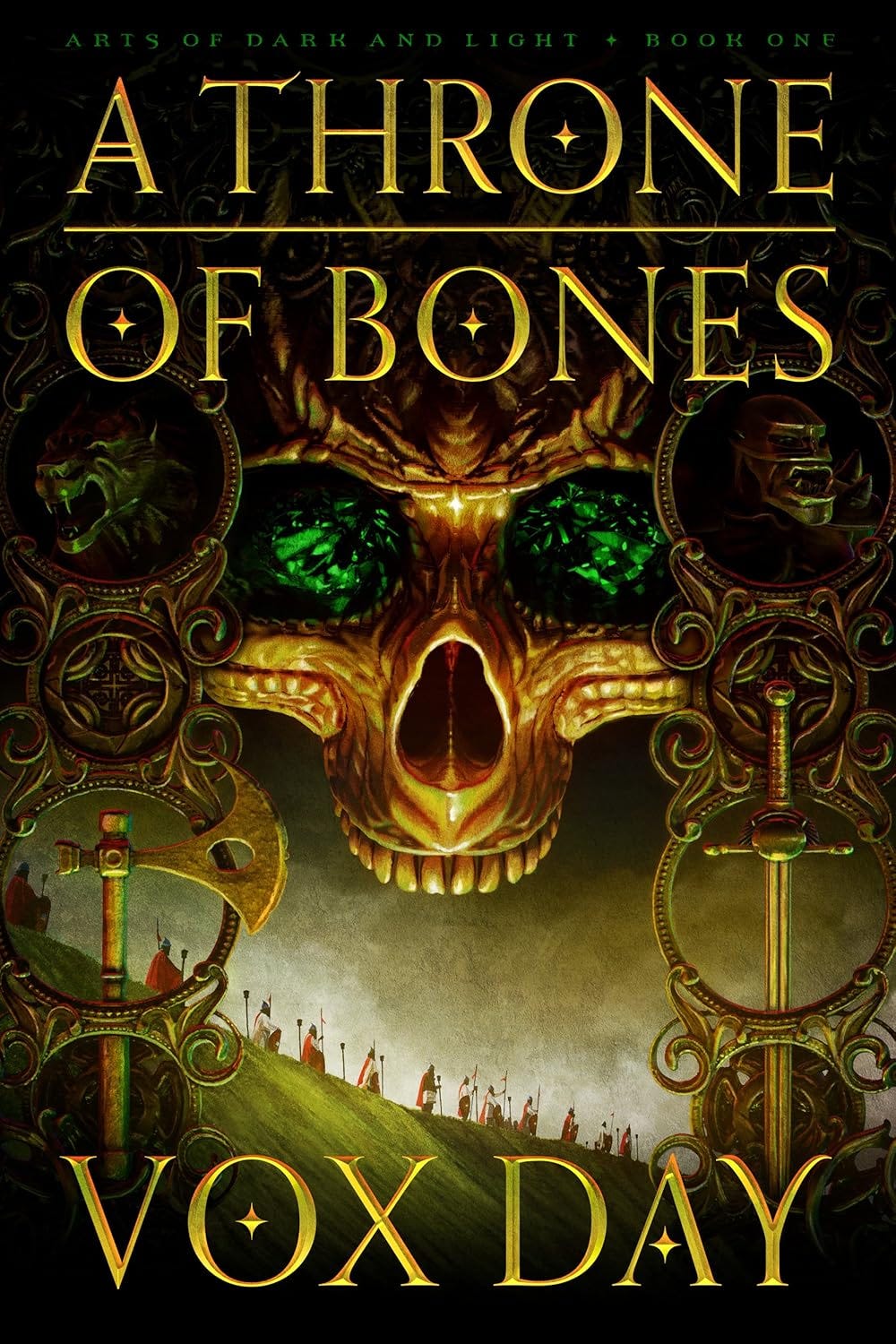
Vox Day’s epic fantasy presents a Roman-inspired empire facing threats from elves, goblins, and internal political intrigue across multiple storylines involving nobles, generals, and clergy. The novel is unapologetically right-wing in its worldview, presenting hierarchical societies as natural and necessary, celebrating martial virtue and strategic intelligence, and treating Christianity (represented by the Church in the fantasy world) as a civilizing force that provides moral structure. Day doesn’t shy away from depicting the brutality of war, the necessity of strong leadership, or the reality that different peoples have different capabilities and interests. The book rejects egalitarian fantasy tropes, showing that societies function best when people fulfill their proper roles rather than pursuing equality. It’s dense, complex, and rewards careful reading, offering a fantasy world where traditional Western values—honor, duty, faith, and hierarchy—are treated as virtues rather than problems to overcome.
The Eye of The World by Robert Jordan (Wheel of Time)

The Eye Of The World opens in a fantasy village after a Trolloc attack, discovering they’re central to prophecies about the Dragon Reborn who will either save or destroy the world. Jordan’s series is right-wing in its structure—it presents a world where prophecy and destiny are real, where some people are born with greater capabilities and responsibilities, and where traditional gender roles (though sometimes inverted for dramatic effect) provide social stability. The series celebrates heroism, self-sacrifice, and the burden of leadership. Jordan, a Vietnam veteran, understood duty and the cost of war, and his characters struggle with the weight of responsibility rather than rejecting it. The magic system has clear rules and costs, the societies have distinct cultures and traditions that matter, and the ultimate conflict is between order (represented by the Light) and chaos (represented by the Dark One). The series is Christian in its underlying metaphysics—there is a Creator, evil is a corruption of good, and redemption is possible through sacrifice.
Solomon Kane by Robert E. Howard

Howard’s Puritan swordsman wanders the world fighting evil wherever he finds it, driven by a grim faith that compels him to be God’s instrument of justice. Kane is explicitly Christian, which makes it more based than Conan. He quotes Scripture, prays before battle, and sees his mission as holy warfare against supernatural and human wickedness. The stories are pulp adventure with a theological edge, presenting a universe where demons are real, where faith provides strength against darkness, and where a righteous man with a sword can make a difference. Howard, though not particularly religious himself, created in Kane a character whose Christianity is central to his identity and motivation. Kane doesn’t fight for glory or wealth—he fights because evil must be opposed, and he’s been called to do it. The stories are short, brutal, and atmospheric, blending swashbuckling action with weird horror while maintaining Kane’s unwavering moral clarity.
Son of the Black Sword by Larry Correia

Correia’s Saga of the Forgotten Warrior follows Ashok Vadal, a magically enhanced warrior who enforces the Law in a caste-based society where gods are dead and demons threaten from below. When Ashok discovers his entire life is built on a lie, he becomes an outlaw fighting against the system he once served. The novel is right-wing in its exploration of order versus chaos, its celebration of martial excellence and personal honor, and its skepticism of systems that claim moral authority without divine sanction. Correia, a practicing Mormon, explores themes of faith, redemption, and the search for truth in a world where the gods are silent. The book doesn’t present easy answers—Ashok’s society is oppressive, but the alternative is demonic invasion. The hero must navigate between law and justice, discovering that true righteousness requires more than following rules. The action is spectacular, the worldbuilding is detailed, and the underlying themes about faith and purpose resonate with religious readers.
Lord of a Shattered Land by Howard Andrew Jones

Jones’s series follows Hanuvar Cabera, a Carthaginian general modeled on Hannibal, as he works to free his enslaved people after his city’s destruction by a Roman-inspired empire. The stories are sword-and-sorcery adventures celebrating honor, loyalty, and the warrior’s code. Hanuvar is a classical hero—intelligent, courageous, and devoted to his people and gods. The series is right-wing in its celebration of martial virtue, its respect for ancient cultures and traditions, and its portrayal of a hero who fights not for personal gain but for his people’s survival and freedom. Jones writes with respect for the ancient world, presenting pagan societies with their own honor codes and religious practices without modern cynicism. The stories are tightly plotted, action-packed, and feature a protagonist who embodies the best of classical heroism—strategic brilliance, physical courage, and unwavering commitment to duty.
Three Hearts and Three Lions by Poul Anderson

Anderson’s novel follows Holger Carlsen, a Danish engineer fighting Nazis in World War II who is transported to a fantasy world where he becomes Holger Danske, a legendary hero defending Christendom against the forces of Chaos. The book is explicitly Christian in its cosmology—the conflict is between the Law (representing Christian order and civilization) and Chaos (representing pagan wildness and demonic forces). Holger fights alongside paladins and saints against trolls, giants, and the Wild Hunt, discovering that his role is to defend Christendom at a crucial moment. Anderson, though not particularly religious, created a fantasy world where Christianity is objectively true and worth defending, where the forces of Chaos seek to destroy civilization, and where heroes are called to stand against darkness. The novel influenced Dungeons & Dragons’ alignment system and established the template for “modern person in fantasy world” stories, but it’s also a serious exploration of what it means to fight for civilization against barbarism.
With these books, one can have the best fantasy journeys right at one’s fingertips. What else would you add?
If you enjoy clean fantasy fiction with great worldbuilding and a classic feel, read The Adventures of Baron von Monocle six-book series and support Fandom Pulse!
NEXT: EXCLUSIVE Interview: Isaac Young On ‘Dead Men Running’ And The Biggest Problem In Modern Culture
Does it have pictures?
I think it counts as fantasy as opposed to sci fi, but Prince of Thorns by Mark Lawrence should be on the list